When $50 Here and $80 There Become $500 a Month
Buy Now, Pay Later can make purchases feel much easier to afford.
A $300 purchase becomes three payments of $100. A $600 purchase might become several smaller instalments.
Individually, each payment can look manageable.
The problem starts when you do it again.
And again.
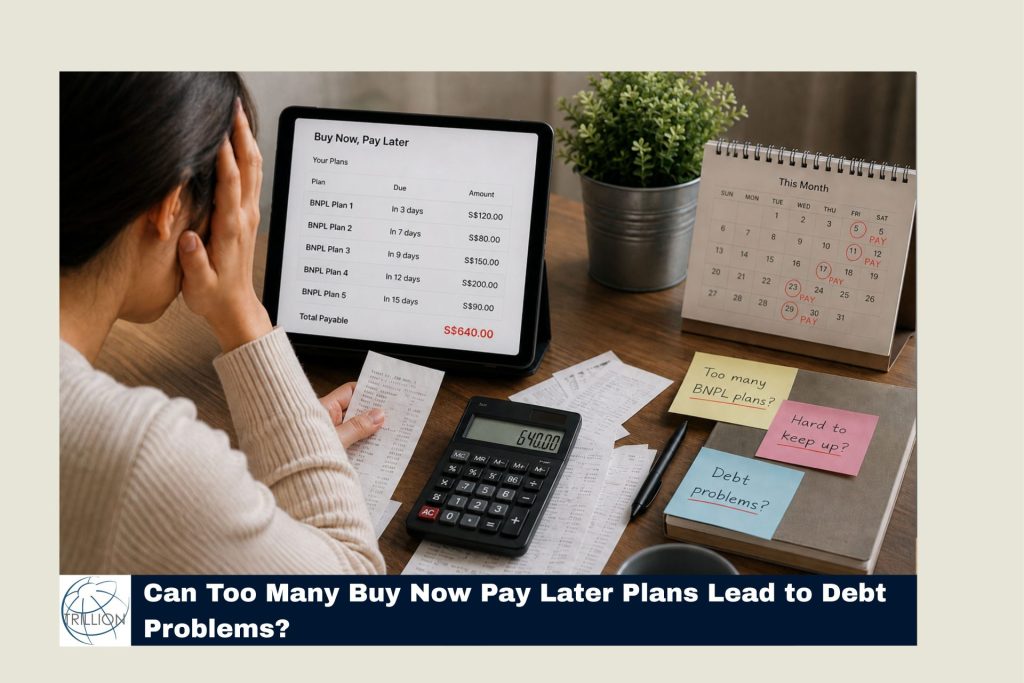
Before long, you might have instalments for your clothes, phone, electronics, travel bookings and online shopping all being deducted from the same month’s salary.
This raises an important question:
Can having too many Buy Now, Pay Later plans actually lead to debt problems?
The short answer is yes — particularly when multiple instalments begin consuming money needed for essential expenses or other financial commitments.
Here’s how it happens, the warning signs to look out for and what you can do before the situation becomes more difficult.
1. BNPL Doesn’t Remove the Cost — It Moves It Into the Future
Imagine you want to purchase a $360 item.
Paying $360 today might make you reconsider the purchase.
But:
$120 × 3 payments
can feel much more affordable.
Financially, however, you’ve still committed $360.
The difference is that some of the cost has been transferred to your future income.
That distinction matters because your future salary will also need to pay for future groceries, transport, utilities, insurance, existing loans and unexpected expenses.
Every new BNPL transaction therefore reduces the amount of your future income that remains available.
2. The Real Danger Is “Instalment Stacking”
One BNPL arrangement may not cause any difficulty.
But consider someone with these purchases:
| Purchase | Monthly BNPL Payment |
|---|---|
| Mobile phone | $150 |
| Clothes | $80 |
| Air tickets | $180 |
| Electronics | $120 |
| Online shopping | $70 |
| Total | $600/month |
None of the individual payments looks particularly large.
But together, $600 of next month’s income has already been committed.
This is why multiple BNPL arrangements can become dangerous.
Singapore’s MoneySense warns consumers that taking on several instalment plans can cause repayments to accumulate and eventually become difficult to manage.
The issue isn’t necessarily one large purchase.
It’s many small commitments happening at the same time.
3. Why BNPL Debt Can Creep Up Without You Realising
Traditional borrowing often feels like borrowing.
You apply for a loan, review the amount, sign an agreement and commit to repayments.
BNPL can feel very different.
It may appear simply as another payment option during checkout:
Pay $300 now
or
Pay $100 × 3
Because it is integrated into the shopping process, consumers may focus more on completing the purchase than thinking about taking on another financial obligation.
That convenience can make it easier to repeatedly commit future income without calculating the combined effect.
4. A Simple Example: How BNPL Can Squeeze Your Monthly Budget
Suppose your take-home income is $3,000 per month.
Your normal monthly commitments are:
| Expense | Amount |
|---|---|
| Household contribution | $700 |
| Food & transport | $700 |
| Insurance & bills | $300 |
| Existing loan repayments | $450 |
| BNPL instalments | $550 |
| Total | $2,700 |
That leaves just $300.
Now imagine an unexpected $500 medical, household or family expense.
Suddenly, there isn’t enough money.
The temptation may then be to:
use another BNPL plan → use a credit card → borrow money → push another expense into next month.
This is how a cash-flow problem can gradually become a debt problem.
5. Warning Signs That Your BNPL Usage Is Becoming a Problem
BNPL isn’t automatically harmful. The important question is whether your repayments remain comfortably affordable.
Watch for these warning signs.
You no longer know how many BNPL plans you have
If you need to check several apps just to understand what you owe, your commitments may already be becoming difficult to manage.
You’re waiting for payday just to cover instalments
Your salary should support your overall living expenses—not simply clear yesterday’s purchases.
You’re using BNPL for everyday necessities
Occasionally spreading the cost of a necessary purchase is one thing.
Regularly using BNPL because you cannot afford groceries or routine expenses may indicate a deeper cash-flow problem.
You’re using one form of credit to pay another
For example:
BNPL payment due → use credit card cash → credit card bill arrives → take another loan.
Moving debt around doesn’t necessarily reduce it.
You avoid checking your outstanding balances
If looking at your repayments causes anxiety, that’s a strong reason to calculate your total commitments immediately.
You’re missing payments
Once repayments are regularly being missed, your financial commitments have likely exceeded what your current budget can comfortably support.
6. What Happens If You Cannot Pay Your BNPL Instalments?
The consequences depend on the BNPL provider and the specific terms of your arrangement.
Depending on those terms, missed repayments can potentially result in:
- late-payment charges;
- suspension of your BNPL account;
- restrictions on making additional purchases;
- collection activity; and
- increasing difficulty managing your other financial commitments.
Consumers should therefore understand the provider’s repayment and late-payment terms before making the purchase, rather than discovering them after a payment has been missed.
For participating providers under Singapore’s BNPL Code of Conduct, consumer safeguards include measures relating to late fees, suspension of further BNPL usage after missed payments and financial-hardship assistance.
7. What Should You Do If You Already Have Too Many BNPL Plans?
The first priority isn’t finding another source of money.
It’s understanding exactly what you owe.
Step 1: List every BNPL commitment
Create a simple table:
| Provider | Outstanding | Next Payment | Final Payment |
|---|---|---|---|
| Provider A | $300 | $100 | October |
| Provider B | $480 | $160 | November |
| Provider C | $200 | $100 | September |
Don’t estimate.
Check the actual outstanding amounts.
Step 2: Calculate your total monthly repayments
Add together all BNPL instalments due next month.
Then add:
- bank loans;
- credit cards;
- licensed moneylender loans; and
- any other repayment obligations.
You now have a much clearer picture of how much income is already committed.
Step 3: Stop adding new instalments
This is critical.
If your current BNPL commitments are already uncomfortable, another “small” instalment makes the problem worse.
Consider temporarily removing BNPL as a payment option or reducing shopping-app usage.
Step 4: Reduce discretionary spending
For the next few months, consider redirecting money from:
- dining out;
- entertainment;
- subscriptions;
- shopping; and
- non-essential purchases
towards clearing existing commitments.
Step 5: Contact providers early if you expect difficulty
Don’t wait until several payments have been missed.
Check what hardship or repayment assistance may be available from the provider.
8. Should You Take a Personal Loan to Clear BNPL Debt?
This requires careful consideration.
If you owe several BNPL providers, combining everything into one repayment may initially sound attractive.
But taking a personal loan doesn’t make the original spending disappear.
You are replacing one set of financial obligations with another.
Before considering another loan, ask:
- How much do I owe across all BNPL plans?
- What other debts do I currently have?
- What would the new loan cost in total?
- Can I genuinely afford the new repayment?
- Will I stop using BNPL after clearing the balances?
That fifth question is particularly important.
If someone takes a loan to clear $2,000 of BNPL balances and then immediately begins using BNPL again, they could eventually end up with:
the new personal loan + new BNPL instalments.
That leaves them worse off than before.
A loan should therefore never be treated as permission to restart spending.
9. BNPL vs Personal Loan: They Solve Different Problems
BNPL and personal loans shouldn’t be viewed simply as competitors.
BNPL generally finances a specific purchase by spreading its cost.
A personal loan provides borrowed funds that are repaid according to an agreed schedule and carries its own interest, fees and obligations.
Neither option makes an unaffordable purchase affordable simply by dividing the cost into instalments.
The important consideration is always:
Can your income comfortably support the repayment without compromising essential expenses?
10. A Useful Rule: Calculate Before You Click
Before making another BNPL purchase, calculate:
Existing BNPL instalments + loan repayments + credit card commitments + essential monthly expenses
Then compare the total against your take-home income.
If there isn’t a comfortable buffer remaining, the answer isn’t another instalment.
It may simply be:
“Not this month.”
That small decision can prevent a much bigger financial problem later.
The Bottom Line: Small Instalments Can Create a Big Commitment
Buy Now, Pay Later can be convenient when used carefully.
But the danger comes when multiple individually affordable payments accumulate into one unaffordable monthly obligation.
If you find yourself:
- juggling several BNPL plans;
- struggling to remember payment dates;
- sacrificing necessities to meet instalments;
- borrowing to make BNPL payments; or
- repeatedly missing payments,
it’s time to stop adding new commitments and reassess your finances.
At our professional licensed moneylending company Trillion Credit, we believe financial products should give consumers greater control—not encourage them to continuously push today’s spending into tomorrow.
Sometimes borrowing can address a genuine short-term financial need.
Sometimes restructuring your spending is the better answer.
And sometimes the most financially responsible decision is simply not buying something yet.
Need Financial Help?
If existing repayments and an unexpected expense have created a genuine cash-flow shortage, review your total financial commitments before taking on additional debt.
If borrowing remains necessary, speak with a licensed moneylender like us to understand the total cost, repayment obligations and whether the proposed loan is genuinely affordable.
Don’t judge a financial commitment by how small the next payment looks. Judge it by whether you can afford the entire obligation.
Need urgent financial assistance? Contact us today to explore safe and transparent emergency loan options tailored to your needs.
Walk into our branch or apply online anytime.
We’re here to provide fast, transparent, and legal cash loans.
📱 Call us at 65090111
📝 Or apply now at https://trillioncredit.com.sg/apply-for-loan/