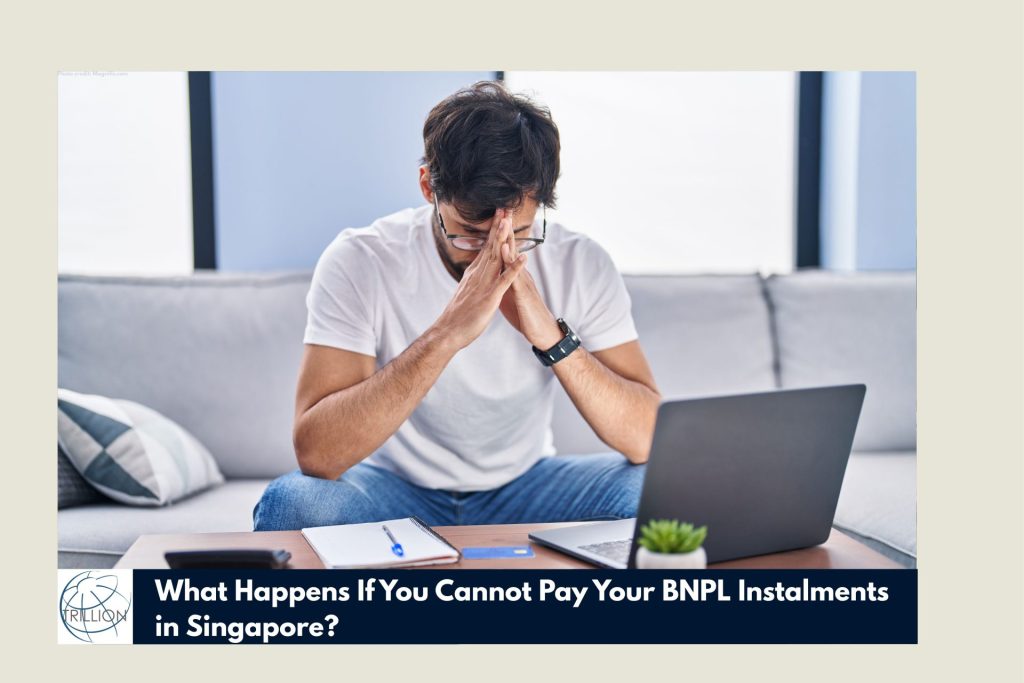
Introduction: Missed a BNPL Payment? Don’t Ignore It
Buy Now, Pay Later can feel harmless when you’re making a purchase.
$300 becomes three payments of $100.
$600 becomes several smaller instalments.
But what happens when those instalments finally become due—and there isn’t enough money in your account?
Perhaps several BNPL plans are due at once.
Perhaps an unexpected bill has used up the money you intended to repay with.
Or perhaps your income this month is simply lower than expected.
If you’re thinking:
“I can’t afford my BNPL payments this month. What happens now?”
The most important thing is not to ignore the problem.
Missing a payment can potentially result in late charges and restrictions, depending on the BNPL provider and the applicable terms. More importantly, repeatedly missing instalments may be a warning that your overall financial commitments have become unaffordable.
Here’s what Singapore consumers should know—and what you can do next.
1. What Happens When You Miss a BNPL Payment?
The exact consequences depend on the BNPL provider and the agreement you entered into.
Consumers should therefore check their particular provider’s current terms rather than assuming that every BNPL service handles missed payments in the same way.
Depending on the arrangement, consequences may include:
- late fees or charges;
- suspension of your BNPL account;
- inability to make further BNPL purchases;
- requests for the outstanding payment; and
- further recovery action if amounts remain unpaid.
This is why the phrase “interest-free” should never be interpreted as:
“Nothing happens if I don’t pay.”
An interest-free payment plan is still a financial commitment.
2. BNPL Code Safeguards in Singapore
Singapore consumers should also be aware of the BNPL Code of Conduct.
MoneySense recommends looking for providers with the BNPL Code Trustmark, which indicates that the provider has committed to safeguards under the industry code.
These safeguards include areas such as:
- fair and clear disclosures;
- suspension of an account upon default;
- not charging compound interest on late payments;
- voluntary exclusion mechanisms; and
- financial-hardship assistance.
This does not mean missed payments have no consequences.
Instead, it means consumers using participating providers have certain safeguards designed to reduce the risk of excessive BNPL debt.
If you’re already experiencing repayment difficulties, check whether your provider offers financial-hardship assistance and contact them early.
3. Can You Be Charged a Late Fee?
Depending on your BNPL provider and the terms of the arrangement, late fees or other charges may apply when payments are missed.
This matters because the original purchase may have been advertised as:
“0% interest”
But “0% interest” does not necessarily mean there can never be another cost.
For example, imagine you purchase something for $300 using three instalments of $100.
If you make every payment correctly under a genuinely interest-free arrangement with no applicable additional charges, you may ultimately pay $300.
But if you begin missing payments, charges may apply according to the provider’s terms.
The purchase can therefore become more expensive than originally expected.
Before using BNPL, always check:
What happens if my payment is one day late?
Is there a late fee?
Is there a cap on late fees?
What happens to my account after a missed payment?
Is hardship assistance available?
Those questions are just as important as asking whether the plan charges interest.
4. Can Your BNPL Account Be Suspended?
It may be.
In particular, providers complying with Singapore’s BNPL Code have committed to suspending further BNPL usage upon default.
At first, being unable to make another BNPL purchase may seem inconvenient.
But there is an important consumer-protection reason for this.
Imagine someone cannot afford this month’s $300 of BNPL repayments.
Allowing that person to immediately make another $500 purchase using BNPL could increase the problem.
Suspending further usage helps prevent:
existing repayment difficulty → additional purchases → even more instalments → greater repayment difficulty.
If your account is suspended because of a missed payment, don’t look for another BNPL provider simply to continue spending.
Treat it as a signal to review your finances.
5. The Bigger Problem May Not Be the Missed Payment
Suppose your missed instalment is only:
$80
It may not look serious.
But ask yourself:
Why couldn’t I afford the $80?
Perhaps it was simply an administrative mistake—you forgot the due date despite having enough money.
That’s very different from:
“I had to choose between paying the $80 instalment and buying groceries.”
The second situation indicates a cash-flow problem.
Look beyond the individual missed payment.
Ask whether your monthly commitments have become too large relative to your income.
6. How Multiple BNPL Plans Can Create a Cash-Flow Problem
Consider someone earning a take-home income of $3,000 per month.
Their monthly commitments might look like this:
| Expense | Monthly Amount |
|---|---|
| Household contribution | $700 |
| Food & transport | $650 |
| Utilities, insurance & bills | $350 |
| Existing loan repayment | $450 |
| BNPL instalments | $550 |
| Total | $2,700 |
That leaves:
$300
Now imagine an unexpected $500 expense.
There isn’t enough money.
The person might then consider:
using a credit card to pay another expense
or
taking another BNPL plan to delay another purchase
or
borrowing money to meet existing repayments.
That’s where the situation can become dangerous.
The original problem isn’t necessarily BNPL itself.
It is that too much future income has already been committed.
7. What Should You Do If You Cannot Pay Your BNPL Instalments?
If you’re already struggling, focus on stabilising the situation rather than finding another way to spend.
Step 1: Stop Making New BNPL Purchases
This should usually be the first step.
Don’t add another instalment while you’re struggling with existing ones.
A new $50 monthly commitment may look small, but it is still another claim against your future income.
Step 2: List Every BNPL Plan You Have
Don’t rely on memory.
Write everything down.
| BNPL Plan | Outstanding Balance | Next Payment | Due Date |
|---|---|---|---|
| Plan A | $300 | $100 | — |
| Plan B | $450 | $150 | — |
| Plan C | $240 | $80 | — |
| Total | $990 | $330 |
Now add your:
- credit-card balances;
- bank loans;
- licensed moneylender loans;
- instalment plans; and
- other debt repayments.
You need to understand your total financial position, not simply the BNPL payment due tomorrow.
Step 3: Work Out What You Can Actually Afford
Start with your take-home income.
Subtract essential expenses such as:
- housing;
- utilities;
- food;
- transport;
- insurance;
- essential family expenses; and
- existing repayment obligations.
Then look at what remains.
If there isn’t enough to cover all your financial commitments, the issue requires more than simply remembering your payment dates.
Your budget needs to change.
8. Contact Your BNPL Provider Early
If you know you’re going to miss a payment, don’t simply disappear.
Contact the provider and explain the situation.
Ask:
What happens if I cannot make the upcoming instalment?
What charges will apply?
Can my repayment arrangement be adjusted?
Do you provide financial-hardship assistance?
Providers complying with the BNPL Code have committed to financial-hardship assistance as one of their consumer safeguards.
The earlier you communicate, the more clearly you can understand the options available under your particular arrangement.
9. Which Bills Should You Pay First When Money Is Tight?
This can be difficult because everyone’s circumstances are different.
But don’t automatically pay whichever company contacts you most aggressively while ignoring essential living expenses.
First identify necessities such as:
- housing;
- basic food;
- utilities;
- essential transport;
- necessary medical expenses; and
- important family obligations.
Then examine your debts and repayment commitments.
Singapore’s MoneySense generally advises consumers managing multiple debts to prioritise debts with the highest interest rates, while reviewing their budget, reducing unnecessary expenses and avoiding too many sources of credit.
The important point is to make a plan rather than randomly shifting money between bills each month.
10. Should You Use a Credit Card to Pay Your BNPL?
Be very careful.
Moving an expense from one form of credit to another does not make the debt disappear.
For example:
BNPL payment due → use available cash to pay BNPL → put groceries on credit card instead.
You may have technically paid the BNPL instalment.
But financially, you may simply have moved the cash-flow shortage onto your credit card.
If that credit-card balance isn’t paid in full, interest may apply and the debt can become increasingly expensive.
This is why constantly moving expenses between BNPL, credit cards and other borrowing can become a debt cycle.
11. Should You Take a Personal Loan to Pay Off BNPL?
Not automatically.
Suppose you have:
$2,000 outstanding across several BNPL plans.
Taking a $2,000 personal loan and clearing them may appear to solve the problem.
But ask:
Is the new loan actually cheaper?
Compare the total interest, fees and repayment amount—not merely the monthly instalment.
Can you comfortably afford the new repayment?
A longer repayment period may reduce the monthly amount but keep you in debt for longer and may increase your overall borrowing cost.
Why did the BNPL debt become unaffordable?
If the underlying issue is overspending, taking another loan does not solve that behaviour.
Will you stop using BNPL afterwards?
This may be the most important question.
If you clear $2,000 of BNPL using a personal loan and then begin using BNPL again, you could eventually have:
Personal loan + new BNPL debt
You’ve turned one problem into two.
12. When Might Borrowing Still Be Considered?
There is an important distinction between:
borrowing to continue discretionary spending
and
having a genuine short-term financial need.
Suppose you have reduced unnecessary expenses and stopped new BNPL purchases, but an unavoidable emergency has created a temporary cash-flow shortage.
You may still consider available financial options.
But before taking another loan, compare:
- how much you actually need;
- the interest rate;
- fees and charges;
- total repayment;
- repayment frequency;
- loan tenure; and
- whether your income can comfortably support the repayment.
A smaller monthly instalment does not automatically mean a cheaper or more suitable loan.
Any new borrowing should improve your financial position—not simply postpone the problem.
13. When Should You Seek Help Instead of Borrowing Again?
There comes a point where another loan may no longer be the appropriate solution.
Warning signs include:
- repeatedly missing repayments;
- borrowing to pay other debts;
- using BNPL for basic necessities because you have no cash;
- maxing out credit facilities;
- having several lenders or credit providers;
- not knowing how much you owe;
- repayments consuming most of your disposable income; or
- being unable to meet essential household expenses.
If several of these describe your situation, the priority should be understanding and managing your existing debts rather than automatically adding another one.
Seek assistance early rather than waiting until multiple accounts are already in serious arrears.
14. What If Your Problem Is Just One Missed Payment?
Don’t panic.
A single missed or upcoming payment does not automatically mean you’re in an uncontrollable debt situation.
Instead:
Check the provider’s terms.
Find out exactly what has happened and whether a charge applies.
Make the payment as soon as reasonably possible if you can afford it.
Don’t allow a manageable problem to remain unresolved unnecessarily.
Review your payment dates.
Consider reminders or automatic payments where appropriate.
Check your other BNPL commitments.
One missed payment may reveal that you have too many instalments occurring around the same period.
Most importantly, understand why the payment was missed.
If you simply forgot, improve your payment system.
If you genuinely didn’t have enough money, review your budget.
15. How to Avoid the Same BNPL Problem Happening Again
Once your repayments are under control, change the way you use instalments.
Before every future BNPL purchase, ask:
Could I afford to pay the full price today?
If not, think carefully about whether the purchase is genuinely affordable.
How much BNPL do I already owe?
Look at all outstanding plans before adding another.
What percentage of next month’s income is already committed?
Don’t assess a new instalment in isolation.
Is this a need or a want?
There’s a major difference between replacing an essential household appliance and buying another pair of shoes because they’re on sale.
What happens if something unexpected occurs next month?
Leave yourself financial breathing room.
A budget with no buffer is vulnerable to even a small emergency.
16. BNPL Isn’t Necessarily the Problem—Unaffordable Spending Is
It is easy to blame a particular financial product.
But BNPL can be manageable when consumers:
- understand the total purchase cost;
- limit the number of instalment plans;
- make repayments on time; and
- buy within their means.
The danger begins when access to instalments changes how much you spend.
A $600 item does not become a $200 item because you pay it in three parts.
And a $1,200 purchase does not become affordable simply because the checkout screen displays a smaller monthly number.
The full price remains the full price.
Conclusion: If You Cannot Pay Your BNPL, Act Early
If you cannot afford an upcoming BNPL instalment, don’t ignore it and don’t automatically borrow somewhere else to make the problem disappear.
Start by understanding the situation.
Stop adding new BNPL purchases.
Calculate exactly how much you owe.
Review your monthly budget.
Contact the BNPL provider early.
Understand any applicable charges and hardship options.
And most importantly:
Don’t solve an existing debt problem by automatically creating a new one.
At our professional licensed moneylending company Trillion Credit in Singapore, we believe borrowing should give consumers greater financial control—not create an endless cycle of repayments.
There are circumstances where a regulated personal loan may address a genuine financial need.
But if you’re already struggling with multiple debts, the first question shouldn’t be:
“Where can I borrow more?”
It should be:
“How do I get my finances back under control?”
That is the foundation of responsible borrowing.
Need Help Understanding Your Borrowing Options?
If an unexpected financial need has created a genuine cash-flow shortage, review your existing BNPL, credit-card and loan commitments before taking on additional credit.
If borrowing remains necessary, speak with us about the loan amount, applicable interest and fees, repayment schedule and affordability before making a decision.
Borrow only what you need. Understand what you will repay. And make sure the repayment fits your budget.
Need urgent financial assistance? Contact us today to explore safe and transparent emergency loan options tailored to your needs.
Walk into our branch or apply online anytime.
We’re here to provide fast, transparent, and legal cash loans.
📱 Call us at 65090111
📝 Or apply now at https://trillioncredit.com.sg/apply-for-loan/