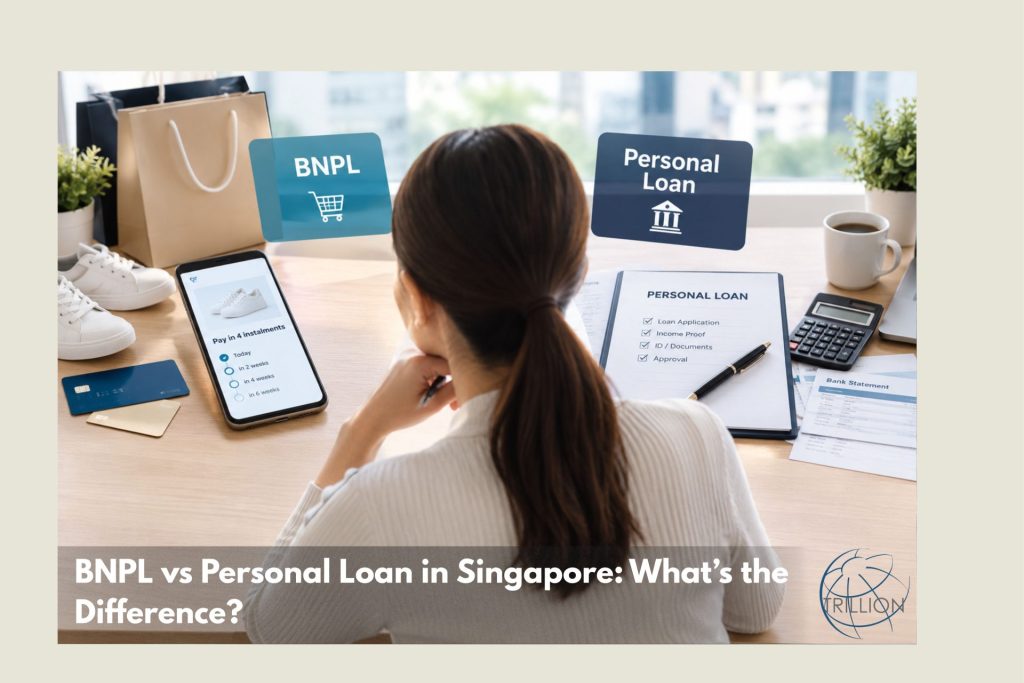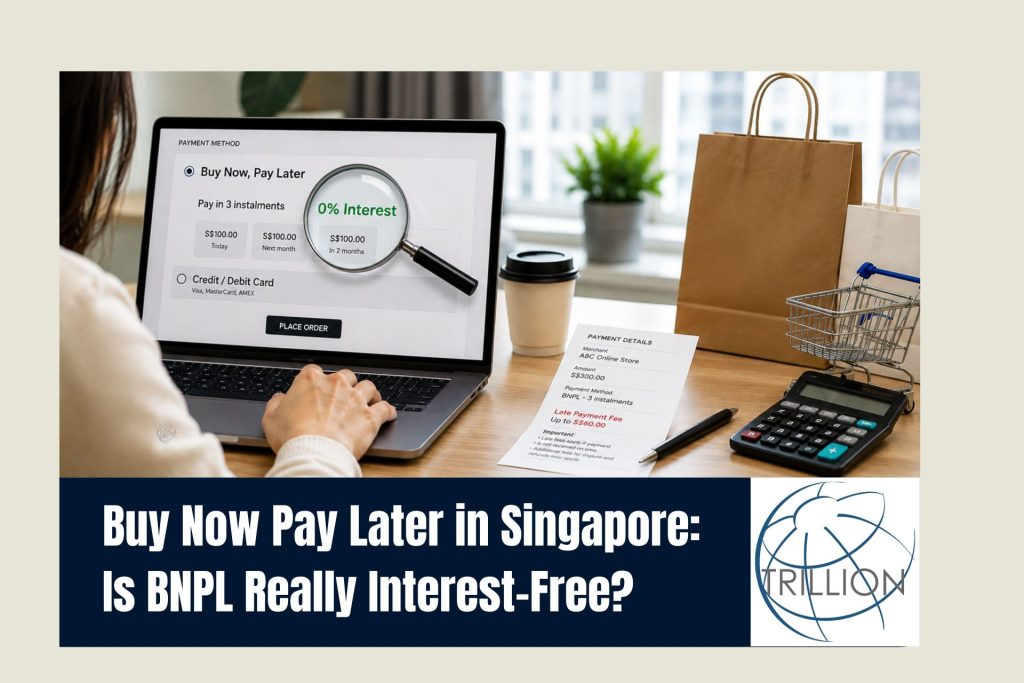
You find something you want for $600.
Paying $600 today feels expensive. But then you see another option at checkout:
$200 today. $200 next month. $200 the month after.
Suddenly, the purchase feels much more manageable.
That is part of the appeal of Buy Now, Pay Later (BNPL). Instead of paying the entire purchase price immediately, you divide it into several smaller payments.
Some BNPL arrangements may also be advertised as interest-free.
But does interest-free mean that using BNPL costs you nothing?
Not necessarily.
The bigger financial risk isn’t always interest. It can be how instalments affect the way you spend — and what happens when several small repayments begin competing for the same monthly income.
Let’s look at how BNPL works and what Singapore consumers should consider before clicking that tempting “Pay Later” button.
1. What Is Buy Now, Pay Later?
Buy Now, Pay Later is a form of deferred payment that allows you to receive a product or service now while spreading payment across several instalments.
Instead of paying $300 upfront, for example, you might pay:
| Payment | Amount |
|---|---|
| Today | $100 |
| Month 2 | $100 |
| Month 3 | $100 |
| Total | $300 |
If there are genuinely no interest charges or other applicable fees and every payment is made according to the terms, you could ultimately pay the same $300 purchase price.
So yes, some instalment arrangements can genuinely allow you to spread payments without paying interest.
But that doesn’t make the purchase cheaper.
You still spent $300.
That distinction is important.
2. Why Does BNPL Make Purchases Feel More Affordable?
Consider these two advertisements:
“New headphones — $450”
versus:
“Get them today from just $150 per instalment.”
They’re describing the same $450 purchase.
Yet $150 can feel much easier to justify.
Breaking a purchase into smaller payments can shift our attention away from the total cost and towards the immediate monthly payment.
Singapore’s MoneySense similarly cautions consumers that instalment plans can make items appear more affordable because the cost is divided into smaller payments.
A useful habit is therefore to ignore the instalment amount for a moment.
Before buying, ask:
“If I had to pay the full $450 today, would I still buy this?”
If the answer is no, the instalment plan may be influencing the decision more than the actual need for the purchase.
3. The Bigger BNPL Risk: Instalment Stacking
One BNPL purchase may be easy to manage.
The problem often begins when you have several.
Imagine having:
- $80/month for shoes
- $120/month for a phone
- $60/month for clothes
- $150/month for electronics
- $90/month for another online purchase
Each transaction individually looks manageable.
Together, however, they represent:
$500 of your next month’s income that has already been committed.
Before you’ve paid for food, transport, utilities, insurance or other debts, $500 is already spoken for.
This is sometimes called instalment stacking.
MoneySense specifically warns that overlapping instalment payments can accumulate and put pressure on monthly cash flow.
4. So Is BNPL Really Interest-Free?
The correct answer is:
It depends on the particular plan and whether you meet its terms.
An advertised interest-free arrangement may not charge interest when payments are made correctly, but consumers should still check for:
- late-payment charges;
- processing or administrative fees;
- missed-payment consequences;
- early repayment or cancellation conditions; and
- other charges stated in the provider’s terms.
The exact terms differ between providers and products.
This is why “0% interest” should never be the only number you look at.
Ask instead:
What is the total amount I will pay if everything goes according to plan — and what could I pay if it doesn’t?
5. What Happens If You Miss a BNPL Payment?
This is where an apparently inexpensive payment arrangement can become more costly.
Depending on the provider and arrangement, missing instalments may result in late charges or restrictions on further use.
Singapore’s MoneySense advises consumers to look for providers carrying the BNPL Code Trustmark. Providers complying with the industry BNPL Code have committed to consumer safeguards including clear disclosures, account suspension upon default, financial-hardship assistance and not charging compound interest on late payments.
Before signing up, understand the provider’s specific missed-payment policy rather than assuming that “interest-free” also means “consequence-free”.
6. BNPL Is Still a Financial Commitment
One of the easiest mistakes is thinking:
“It’s only $50 a month.”
But that $50 isn’t merely a future expense.
It is a commitment against income you haven’t received yet.
Suppose your take-home income next month is $2,800 and you already have:
| Commitment | Monthly Amount |
|---|---|
| Household expenses | $1,200 |
| Transport & food | $700 |
| Existing loan repayments | $400 |
| BNPL instalments | $350 |
| Total committed | $2,650 |
That leaves only $150 before any unexpected expense occurs.
An urgent medical bill or household repair could then create a cash-flow shortage.
The problem wasn’t necessarily one BNPL purchase.
It was the combined effect of multiple financial commitments.
7. Before Using BNPL, Ask Yourself These 5 Questions
Would I buy this if BNPL wasn’t available?
If you wouldn’t pay the full price, reconsider whether you really need it.
How many instalment plans do I already have?
Don’t evaluate the new purchase by itself. Add up every existing instalment first.
Can I afford all the repayments from my normal income?
Don’t rely on an uncertain bonus, overtime payment or future income increase.
What happens if my income unexpectedly falls?
Consider whether you could still meet your commitments after an emergency.
Am I using BNPL for convenience — or because I cannot actually afford the item?
This may be the most important question of all.
If BNPL is the only reason you can make the purchase, delaying the purchase and saving for it may be the safer financial choice.
8. When Can BNPL Be Useful?
BNPL itself isn’t automatically bad.
Used carefully, spreading a necessary expense over several payments can help with short-term cash-flow management.
The key difference is between:
using instalments strategically
and
depending on instalments to maintain a lifestyle you cannot currently afford.
A financially disciplined consumer knows the total amount committed and has sufficient cash flow to make every repayment.
9. What If You Already Have Too Many BNPL Payments?
Start by listing every outstanding instalment:
Provider → remaining balance → monthly payment → payment date → final payment date
Then calculate how much of your monthly income is already committed.
If the amount is becoming difficult to manage:
- stop adding new BNPL purchases;
- reduce discretionary spending temporarily;
- prioritise upcoming repayment dates;
- contact the provider early if you expect difficulty paying; and
- avoid automatically taking on another debt simply to maintain discretionary spending.
The goal is to reduce your commitments, rather than continuously replacing one payment obligation with another.
10. Should You Take a Personal Loan to Pay Off BNPL?
Not automatically.
Taking another loan simply because several BNPL instalments have become uncomfortable can shift debt from one place to another without addressing the underlying cash-flow problem.
Before considering any additional borrowing, calculate:
Total outstanding BNPL + other debts + essential expenses + monthly disposable income.
If your commitments are already beyond what your income can comfortably support, adding another loan may make the situation worse.
If you have a genuine short-term financial need and are considering borrowing, compare the total repayment, fees, repayment period and affordability rather than focusing only on the monthly instalment.
The Bottom Line: “Interest-Free” Doesn’t Mean “Risk-Free”
BNPL can be convenient.
It can also make it remarkably easy to commit tomorrow’s income to today’s purchases.
The important question therefore isn’t simply:
“Does BNPL charge interest?”
It is:
“Can I comfortably afford the total purchase and all of my existing commitments?”
Before clicking Buy Now, Pay Later, look beyond the attractive instalment figure. Check the total cost, understand the terms, add up your existing commitments and make sure future repayments fit comfortably within your budget.
At Trillion Credit, we believe financial control starts before a person borrows. Understanding BNPL, credit, loans and repayment obligations helps consumers make better decisions — and sometimes the best financial decision is choosing not to take on another commitment at all.
Need Help Understanding Your Borrowing Options?
If an unexpected financial need has created a genuine cash-flow shortage, understand your existing commitments before taking on additional credit.
If borrowing is still necessary, you may speak to us about the available regulated options, repayment terms and affordability before making a decision.
Borrow for a reason. Understand the cost. Make sure you can repay.
Need urgent financial assistance? Contact us today to explore safe and transparent emergency loan options tailored to your needs.
Walk into our branch or apply online anytime.
We’re here to provide fast, transparent, and legal cash loans.
📱 Call us at 65090111
📝 Or apply now at https://trillioncredit.com.sg/apply-for-loan/