Both Let You Pay Later — But They Are Not the Same Thing
You need to spend $1,500.
At checkout, you’re offered Buy Now, Pay Later (BNPL).
Another option is to apply for a personal loan and repay the borrowed amount over an agreed period.
Both involve committing future income.
But they work very differently.
BNPL is generally connected to a specific purchase and divides that purchase into instalments.
A personal loan provides you with a sum of borrowed money, which you repay according to the lender’s agreed repayment schedule, with applicable interest and fees.
So which should you choose?
The answer shouldn’t simply be:
“Whichever has the smaller monthly instalment.”
You need to consider why you’re borrowing, how much the financing will cost and whether your income can comfortably support the repayments.
1. What Is Buy Now, Pay Later?
BNPL allows you to purchase something today while dividing the payment into several instalments.
For example:
Purchase price: $600
Instead of paying $600 immediately, an arrangement might divide it into:
$200 + $200 + $200
Certain BNPL arrangements may be interest-free when their terms are followed.
This can make BNPL useful for managing the timing of an affordable purchase.
But there is an important point:
BNPL does not make the product cheaper.
A $600 phone is still a $600 phone.
Breaking the price into smaller amounts merely changes when you pay for it.
Singapore’s MoneySense similarly cautions that BNPL and instalment plans can make expensive products appear more affordable because consumers focus on the smaller payment instead of the overall purchase price.
2. What Is a Personal Loan?
A personal loan works differently.
Instead of financing one checkout transaction, you borrow an agreed sum from a lender.
The money may then be used for the purpose for which you obtained the loan, subject to the lender’s terms.
You subsequently repay the loan according to an agreed repayment schedule.
Depending on the product, your repayments can include:
principal + interest + applicable fees
Personal loans are generally unsecured, meaning you do not pledge an asset such as your home as collateral.
The crucial difference is that a personal loan is borrowing money, rather than simply selecting an instalment option attached to a particular purchase.
3. BNPL vs Personal Loan at a Glance
| Feature | BNPL | Personal Loan |
|---|---|---|
| Typical purpose | Financing a particular purchase | Borrowing a sum of money |
| Where obtained | Usually during/around checkout | Bank, financial institution or licensed moneylender |
| Repayment | Predetermined instalments | Agreed repayment schedule |
| Interest | Some arrangements may be interest-free | Interest generally applies |
| Other charges | Depends on provider and terms | Depends on lender/product and applicable regulations |
| Access to cash | Generally linked to purchasing goods/services | Loan funds are disbursed to borrower |
| Main risk | Stacking multiple small instalments | Taking on a larger debt than you can afford |
| Best question to ask | Can I afford the full purchase? | Do I genuinely need to borrow this amount? |
The important point is that they solve different financial needs.
4. When Does BNPL Make Sense?
Imagine your washing machine unexpectedly breaks.
A replacement costs:
$600
You have sufficient income to afford the purchase, but paying the entire $600 immediately would leave this month’s cash flow unusually tight.
An interest-free BNPL arrangement might allow you to spread that $600 across several payments.
If you:
- genuinely need the item;
- understand all the terms;
- have no excessive existing instalments; and
- can comfortably make every payment,
BNPL may be a reasonable way of managing the timing of that purchase.
The important phrase is:
“I can afford this purchase.”
Not:
“I can only afford this because BNPL exists.”
There is a major difference.
5. When Might Someone Consider a Personal Loan Instead?
A personal loan may be considered when the financial need isn’t simply a purchase available through a BNPL checkout.
For example, you may have an unexpected expense that requires an actual sum of money rather than an instalment arrangement with a merchant.
The important questions then become:
How much do I actually need?
How quickly can I repay it?
What is the total borrowing cost?
Can I afford the repayments after paying my essential expenses?
A personal loan may offer a structured repayment schedule, but that does not automatically make it the better choice.
You are still taking on debt.
6. Is BNPL Cheaper Than a Personal Loan?
Sometimes—but this question needs context.
Suppose a BNPL arrangement is genuinely interest-free and you make every payment according to its terms.
In that case, financing that particular purchase may cost less than taking an interest-bearing personal loan to buy the same item.
But don’t stop the comparison there.
You also need to check:
- late-payment charges;
- other applicable fees;
- repayment dates;
- number of instalments; and
- whether you already have other BNPL commitments.
For a personal loan, consider:
- advertised interest rate;
- how interest is calculated;
- effective interest rate where applicable;
- processing or administrative fees;
- late-payment charges;
- repayment tenure; and
- total amount repayable.
The monthly instalment alone is not enough to compare borrowing costs.
7. Why the Lowest Monthly Payment Can Be Misleading
Consider two hypothetical options for the same financial need.
Option A
Repay:
$500 per month for 3 months
Option B
Repay:
$150 per month for 12 months plus interest and applicable charges
Option B looks easier because $150 is much smaller than $500.
But it doesn’t necessarily mean Option B is cheaper.
A longer repayment period can reduce your immediate monthly burden while increasing how long you remain in debt and, depending on the loan structure, the total interest paid.
MoneySense advises consumers to look at the Effective Interest Rate (EIR) where relevant, fees and repayment schedule when comparing loan products. It also notes that, generally, longer loan tenures result in more interest being paid.
So don’t ask only:
“How much do I pay each month?”
Ask:
“How much will I have paid when everything is finished?”
8. The Biggest BNPL Risk: Too Many Small Commitments
BNPL has a particular psychological risk.
One transaction might be:
$60 per month
Another:
$90 per month
Another:
$120 per month
And another:
$80 per month
Individually, none looks particularly worrying.
Together:
$60 + $90 + $120 + $80 = $350 per month
You’ve committed $350 of future income.
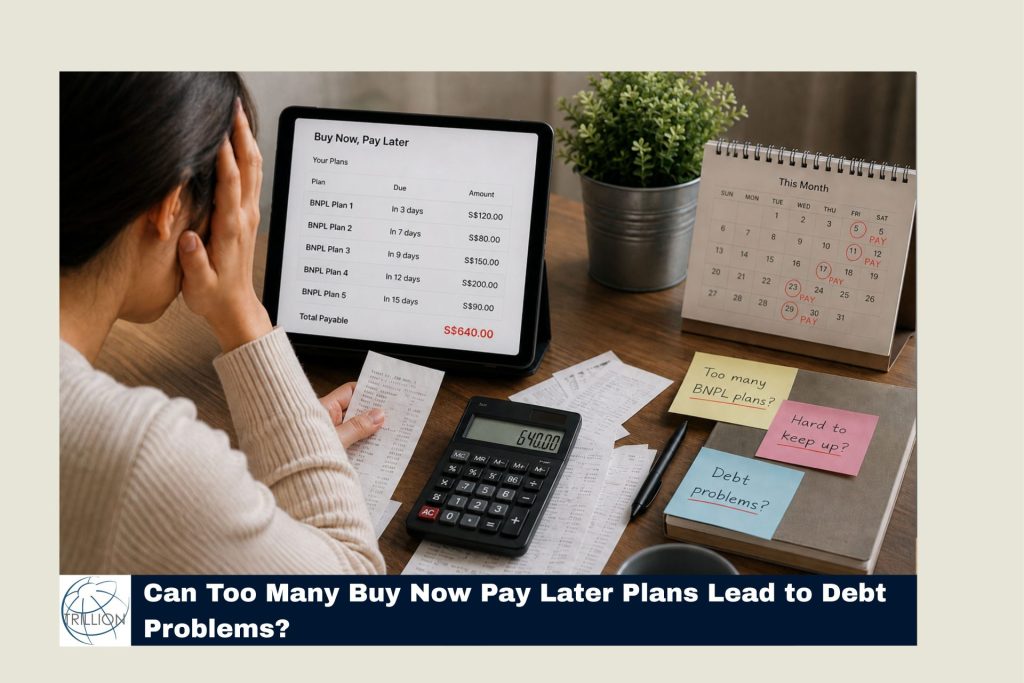
This is why BNPL can become difficult to manage even when every individual purchase appeared affordable at checkout.
MoneySense warns that overlapping instalment payments can accumulate and strain monthly cash flow.
Before making another BNPL purchase, calculate your total existing instalments, not simply the price of the next one.
9. The Biggest Personal Loan Risk: Borrowing More Than You Need
Personal loans have a different risk.
Suppose you need:
$1,500
but you’re offered:
$4,000
The larger amount may be tempting.
You might think:
“I can use the extra money for other things.”
But additional borrowing means additional repayment obligations.
Eligibility for a larger loan doesn’t mean taking the maximum amount is financially sensible.
If your genuine need is $1,500, start by asking why you would borrow $4,000.
Borrow what you need—not simply what is available.
10. BNPL vs Personal Loan for Shopping
For ordinary discretionary shopping, the first option should often be neither.
Imagine you want a new $1,500 phone even though your existing phone works perfectly well.
You could:
use BNPL
or
take a personal loan
or
save for several months and buy it later.
That third option sometimes disappears from consideration because credit makes immediate purchasing so easy.
Before financing a discretionary purchase, ask:
Would I still buy this if I had to pay the full amount in cash today?
If the answer is no, consider waiting.
11. BNPL vs Personal Loan for an Emergency
Emergencies are different.
Imagine an essential expense appears unexpectedly and you genuinely do not have enough savings.
Before borrowing, first establish the actual shortage.
For example:
Emergency expense: $2,000
Available savings: $800
Actual shortage: $1,200
Your financing question should therefore begin with:
“How do I manage the $1,200 shortfall?”
—not—
“How much can I borrow?”
Then compare whatever legitimate options are available based on:
- total borrowing cost;
- monthly repayment;
- repayment duration;
- applicable fees;
- consequences of late payment; and
- your existing financial commitments.
This is a much healthier approach than simply taking the largest amount offered.
12. Should You Take a Personal Loan to Pay Off BNPL?
This deserves special attention.
Suppose you’ve accumulated:
BNPL Plan A + BNPL Plan B + BNPL Plan C + BNPL Plan D
and now you’re struggling with several payment dates.
You may consider taking one personal loan to clear them.
That can make the repayment structure appear simpler.
But it does not automatically improve your financial situation.
Before doing this, compare:
Total BNPL amount outstanding
Know exactly what you owe.
Cost of the proposed personal loan
Calculate the interest, fees and total repayment.
New monthly repayment
Can you genuinely afford it?
Repayment duration
Are you turning short instalments into a much longer debt?
Your spending behaviour
Will you stop using BNPL afterwards?
That last question is critical.
If you take a personal loan to clear $2,000 of BNPL and then start using BNPL again, you could soon have:
Personal loan + new BNPL commitments.
Instead of consolidating your problem, you’ve increased it.
MoneySense similarly advises consumers not to borrow from another source to repay existing debts without first comparing the interest charges and fees.
13. What About a Licensed Moneylender Personal Loan?
If you’re unable to obtain a bank loan or have a genuine short-term financial need, you may consider whether borrowing from a licensed moneylender in Singapore is appropriate for your circumstances.
But the same principle applies:
A licensed moneylender loan should not be treated as extra spending money.
Before signing, understand:
- the principal amount;
- interest rate;
- administrative or other permitted fees;
- repayment frequency;
- loan tenure;
- total repayment;
- late-payment consequences; and
- whether the repayments fit within your budget.
And borrow only from a moneylender listed on Singapore’s official Registry of Moneylenders.
The purpose should be addressing a genuine financial need—not financing a continuous cycle of discretionary BNPL spending.
14. A New Protection for Licensed Moneylender Borrowers
There is also a recent development Singapore borrowers should know about.
From 15 September 2026, eligible unsecured loans from licensed moneylenders, other than business loans, are subject to a mandatory three-business-day cooling-off period.
This gives eligible borrowers an opportunity to reconsider their need for the loan and cancel during the applicable period at reduced cost under the new framework.
If you’re considering a licensed moneylender personal loan, read our guide:
“New 3-Day Cooling-Off Period for Licensed Moneylender Loans in Singapore: What Borrowers Need to Know.”https://trillioncredit.com.sg/new-3-day-cooling-off-period-for-licensed-moneylender-loans-in-singapore-what-borrowers-need-to-know/
Understanding your rights is part of responsible borrowing.
15. BNPL or Personal Loan? Ask These 7 Questions
Before choosing either option, answer these questions.
1. Is this a need or a want?
An emergency expense is very different from a sale purchase.
2. What is the total amount I need?
Don’t borrow more simply because it is available.
3. What is the total cost?
Include interest and applicable fees—not only the first instalment.
4. How much do I already owe?
Include BNPL, credit cards and existing loans.
5. Can my income support the repayment?
Calculate affordability after essential expenses.
6. What happens if my income drops unexpectedly?
Leave some financial breathing room.
7. Could I wait and save instead?
For non-essential purchases, this may be the cheapest option of all.
16. So, Which Is Better: BNPL or a Personal Loan?
There is no universal winner.
BNPL may be suitable when:
- you are financing a specific necessary purchase;
- the arrangement is genuinely low-cost or interest-free;
- you understand the terms;
- you have few other instalment commitments; and
- you can comfortably afford every payment.
A personal loan may be considered when:
- you have a genuine need for funds rather than simply financing a checkout purchase;
- you understand the total borrowing cost;
- the repayment schedule suits your cash flow; and
- you can comfortably repay the loan.
Neither may be suitable when:
- the purchase is non-essential and unaffordable;
- you’re already struggling with debt;
- you’re borrowing simply to make other repayments;
- your monthly commitments leave little money for necessities; or
- you’re relying on future borrowing to maintain current spending.
Sometimes the right answer isn’t:
BNPL or personal loan?
It’s:
“Wait, save and don’t borrow yet.”
Conclusion: Choose Based on the Financial Need, Not the Convenience
BNPL and personal loans can both allow you to pay for something today using future income.
But they are different tools.
BNPL is generally tied to purchases and can make it convenient to divide costs into smaller payments.
A personal loan gives you a sum of borrowed money with an agreed repayment structure and borrowing cost.
Neither automatically makes an expense affordable.
At our professional licensed moneylending company Trillion Credit in Singapore, we believe the purpose of borrowing should be to help consumers manage genuine financial needs—not encourage unnecessary spending.
Before choosing BNPL or a personal loan:
Understand why you need the money.
Calculate what you can afford.
Compare the total cost.
Check your existing commitments.
And then decide whether borrowing is necessary at all.
Need a Personal Loan for a Genuine Financial Need?
If you have an unexpected cash-flow shortage and are considering a personal loan, speak with us about your circumstances before deciding.
We will explain the loan amount, applicable interest and fees, repayment schedule and relevant borrower protections so you can understand the commitment before proceeding.
Borrow what you need—not what you can spend.
Walk into our branch or apply online anytime.
We’re here to provide fast, transparent, and legal cash loans.
📱 Call us at 65090111
📝 Or apply now at https://trillioncredit.com.sg/apply-for-loan/